NEW ORLEANS –– As with any major storm, Southern Baptist Disaster Relief (SBDR) crews staged personnel and equipment in several inland cities in August 2005 as Hurricane Katrina prepared to make landfall. Little did they know, those volunteers were in the vanguard of one of SBDR’s defining, historic responses.
“The volunteers just couldn’t get over it, the damage, the emptiness of the city, the emptiness of the communities.” recounted Mickey Caison, who served as the national SBDR director at the North American Mission Board (NAMB) at the time.
“Nobody was there when we first started. They couldn’t live there. They couldn’t be there,” Caison said, describing the scene in the early days of the response as most residents had evacuated. “The damage, the flooding, as well as the electricity and utilities and things like that were not available. It was just overwhelming, the darkness, for so many of the volunteers.”
Katrina’s path toward the Gulf Coast had been tumultuous, unpredictable. Just before landfall, Caison said, there was a window of a few hours where it seemed the storm’s path had shifted eastward enough that the major metropolitan area of New Orleans was going to avoid the brunt of Katrina’s wrath.
But the tidal surge overwhelmed the levy system, and the below-sea-level city of New Orleans flooded for more than two weeks.
The aerial images of stranded survivors captured the hearts of Americans as well as others around the world. The Mississippi Gulf Coast—cities like Biloxi, Gulfport, and Pascagoula—also endured overwhelming damage.
“We immediately realized that we were going to have two major fronts to deal with: Mississippi and then Louisiana and New Orleans,” said Caison. NAMB took the primary role in organizing the national SBDR response in New Orleans while Mississippi Baptists took the lead in their state.
All told, nearly 1,400 people died, most in New Orleans—the third-deadliest storm in U.S. history since 1900—and Katrina remains the costliest storm in the nation’s history.
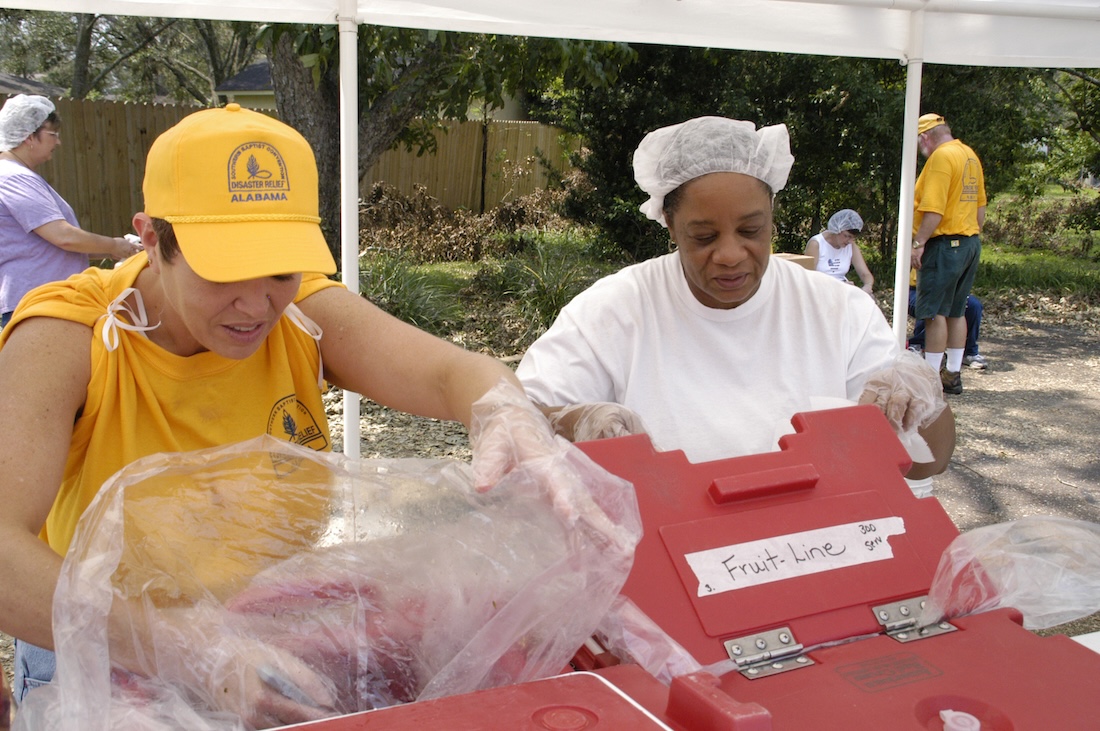
Within the first week, Southern Baptists prepared more than 1.3 million meals, many of which were distributed by the American Red Cross. SBDR activated 200 mobile disaster relief units and roughly 5,000 trained volunteers throughout the region in the opening days of the response.
“They were first on the scene and seem to be everywhere, even in areas where no one else has gone yet,” Don Mackens of Hattiesburg, Miss., told Baptist Press at the time. “What a testimony you have been for our Lord. It makes us proud to be Southern Baptist.”
In any response, there are typically two phases: recovery and rebuild. During recovery, volunteers cook and provide meals, clear downed trees and other storm debris, get muck out of flood-damaged homes, and meet other immediate needs.
Katrina’s devastation launched a 196-day recovery period that lasted from August 29, 2005, to March 12, 2006. Nearly 21,000 volunteers from 41 Baptist state conventions served during that time. They completed 17,000 recovery jobs and prepared more than 14.6 million meals.
One million of those meals were prepared at the SBDR site on the Calvary Baptist Church campus in New Orleans. Keith Manuel, director of evangelism and church growth for the Louisiana Baptist Convention, pastored Calvary Baptist at the time when the SBDR unit from Missouri Baptists arrived on the scene.

“They set up and started serving meals, and Red Cross came in after that. Then we had volunteers coming from around the nation at that point,” Manuel said. “Literally, somebody from every state in the United States slept in my worship center, including Alaska and Hawaii.”
As SBDR volunteers prepared the meals in the mobile kitchen and provided survivors with resources from the campus, the Calvary Baptist campus hosted between thirty and forty American Red Cross emergency response vehicles, some of which would drive 100 miles round trip each day to get food far out into the surrounding area.
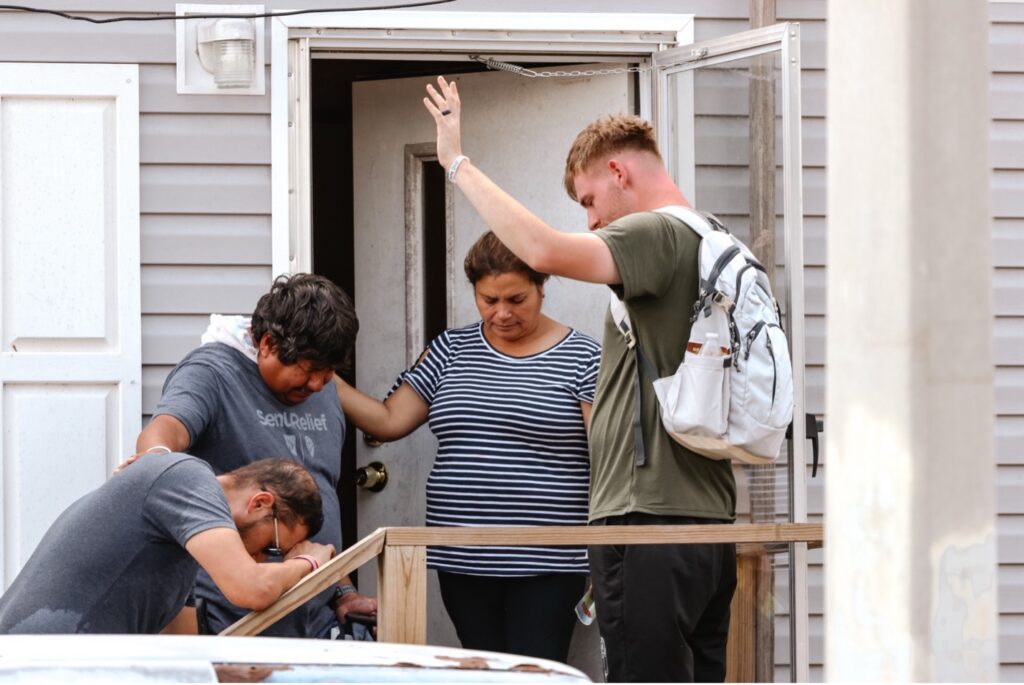
Volunteers with SBDR along with Calvary Baptist members actively prayed for, ministered to, and shared the gospel with people.
“We’d have cars wrapped all the way around the property,” Manuel said. “They were leading people to the Lord right and left.”
For years, the church continued meeting people who remembered how the activity and resources flowing through the church helped them.
“I don’t know how anyone who went through that couldn’t one hundred percent support the work of the North American Mission Board and love Southern Baptists,” said Manuel, “because, in the hardest of times, they showed up in droves.”

Dating back to SBDR’s inception in 1967, SBDR had established a significant force of volunteers and recovery units, but the Southern Baptist response to Katrina elevated interest in serving with SBDR to an entirely new level.
The volunteer base nearly doubled five years after Katrina made landfall, reaching 95,000 trained volunteers and roughly 1,600 mobile units that provided feeding, chainsaw work, debris removal, and other essential needs following a major disaster.
In response to the 9/11 terrorist attack a few years prior, SBDR had begun to utilize more trained chaplains who supplied emotional and spiritual care to survivors of major crises. That emphasis on chaplaincy played a major role in providing immediate and eternal hope to those wrestling with the tragedy of Katrina.
Katrina was also the response where SBDR began tracking gospel presentations and responses, said Caison.
“Coming out of Katrina, the whole focus ratcheted up to a higher degree,” he said, “thinking about the professions of faith and the presentations of the gospel, not just a social ministry but an evangelistic tool as well.”
The galvanizing effect the Katrina response had on SBDR elevated the ministry’s reputation nationally.
“There was a significant change in the perception of Southern Baptists coming out of Katrina,” Caison said in a Baptist Press story reflecting on the 10-year anniversary. “We went from an organization that worked with Red Cross and FEMA (the Federal Emergency Management Agency) to an organization worthy of a relationship and a commitment from FEMA. It gave us a different kind of credibility in the eyes of emergency managers and government officials.”
After the lengthy recovery phase, Southern Baptists shifted into a rebuild phase that would last another three years through Operation NOAH (New Orleans Area Homes) and engage 26,000 volunteers as they repaired homes, schools, churches, and other ministry facilities.
Those volunteers, who usually stayed for a week at a time, rebuilt about 500 homes and repaired 26 other water-damaged churches, schools, and other ministry centers. Volunteers also traveled to Mississippi and assisted with the rebuild of hundreds of homes along the Gulf Coast.
Fred Luter has pastored Franklin Avenue Baptist Church in New Orleans since 1986 and served as president of the SBC from 2012-14.
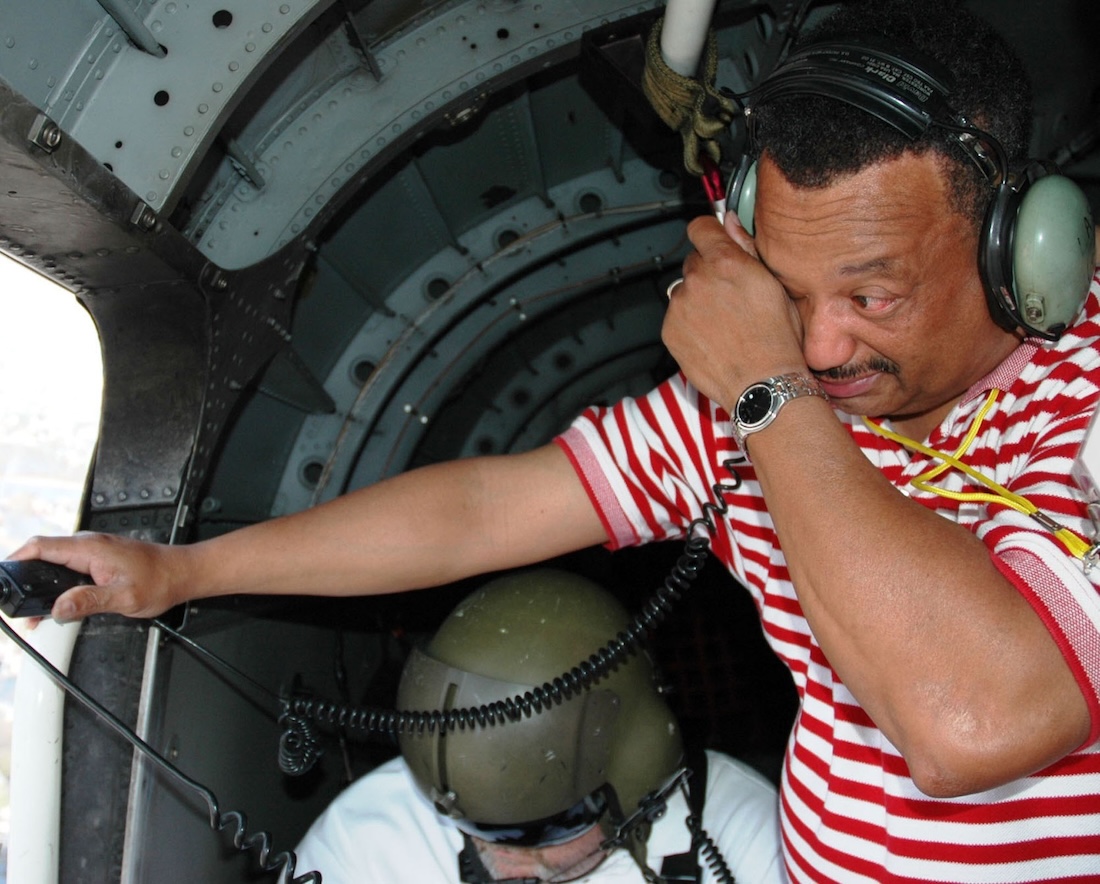
“Being there in New Orleans after Hurricane Katrina, I saw missionaries and disaster relief volunteers come here from all over the country to help those of us in the city, whether it was to gut out our homes or our churches or to help us to paint or cut grass,” said Luter when reflecting on the crisis during the tenth anniversary.
The volunteers who give of their time to get trained and then spend several weeks in disaster areas function as the backbone of SBDR. From Katrina, to 2017’s Hurricane Harvey, 2018’s Hurricane Michael, and up to 2024’s Hurricane Helene, Southern Baptists continue to be among the first to arrive and the last to leave.
“It never ceased to amaze me what volunteers would do,” said Caison. “They would go to a community, and you had dentists, doctors, attorneys all working on feeding lines. They would be in houses mudding them out, cleaning them up, tearing them down. It’s unbelievable what these people would do to serve the Lord.”
Today, SBDR’s work continues to evolve and grow, as it is now undergirded by resources from and national coordination by Send Relief, Southern Baptists’ global compassion ministry founded in 2016 that is a joint effort of the International Mission Board and NAMB.